
It's not a search problem. It's a signal problem.
PDAOAI™ is Oncotelic's Knowledge Discovery platform, powered by Structural Intelligence — it folds 28 million papers into structure and finds the root driver, not proximity. It runs in two modes: Knowledge Discovery for drug discovery, and PDAOAI Robotics — PUR-E and LIM-E for AI-powered GMP manufacturing. Same engine. Two corpora.
Knowledge Discovery
Structural Intelligence — it finds the root driver, not the nearest match. From 28 million PubMed papers, surface the upstream gene, mechanism, or theme — the few things everything else moves around. Vector search returns proximity; we return the signal.
PDAOAI Robotics
The same engine, pointed at your SOPs and batch records — riding on two autonomous robots: PUR-E in the cleanroom, writing the electronic batch record hands-free as the operator dictates through Kebbi, and LIM-E moving materials in the corridors.

Built on Qdrant. We run 28 million vectors in production on its hybrid search, payload filtering, HNSW indexing, quantization, and TurboQuant.
The totality of biomedical knowledge, put to work.
PDAOAI™ is Oncotelic's knowledge discovery platform — proven the hard way. It was designed around the Sapu Nano pipeline — the engine that took two drugs, SAPU 003 and SAPU 006, from concept to first-in-human in 24 months. It reads the full public PubMed corpus — about 28 million abstracts. LLMs and vector search fall apart on biology — the signal drowns in the noise and "closest" returns proximity, not cause; PDAOAI's proprietary clustering, folding, and shell-sampling methods reshape the hyperdimensional space and sample a bounded shell of the manifold — clearing the ghosts, the phantom matches that look related but aren't — to surface the root driver. This is knowledge discovery, not information retrieval — Structural Intelligence that returns insight, auditable to the source and embeddable into the systems where research and manufacturing actually happen.
~28M
PubMed abstracts indexed · refreshed daily
<2 yrs
discovery-to-IND, two programs
2 INDs
SAPU 003 & SAPU 006 filed
Live
production-scale on Qdrant
Built on Qdrant. We run 28 million vectors in production on its hybrid search, payload filtering, HNSW indexing, quantization, and TurboQuant.
From the literature to the lab floor
One engine. Two jobs. PDAOAI finds the root driver in the literature — then runs that same knowledge layer on the GMP floor.
Find the root driver
Vector search hands you the crowd. PDAOAI hands you the cause — the upstream gene everything else moves around.
See how it finds YAP1 →Run it on the GMP floor
The same engine, riding two robots into the cleanroom — writing the batch record as the work happens, right the first time.
Meet PUR-E & LIM-E →Find the root driver the crowd can't see.
We pointed an AI at 28 million papers and asked one question: what drives a cancer? It returned one gene — YAP1 — and it held up against patient data it had never seen. That's Structural Intelligence: it finds the root driver, not the nearest match.
Not better search. Not bigger AI. It's not a search problem — it's a signal problem.
Today's AI can't do this. A bigger context window holds more text, not more understanding — the signal drowns in the noise — and vector search returns proximity, not cause. PDAOAI's proprietary methods — clustering, manifold folding, and shell sampling — reshape the hyperdimensional space so related concepts cluster and unrelated ones pull apart, then surface the root driver from a bounded shell. Knowledge discovery, not information retrieval.
Ingest → Fold → Sample → Discover
Ingest
Index ~28M PubMed abstracts and proprietary corpora — the totality of biomedical knowledge, refreshed daily.
Fold
Fold the hyperdimensional space so related concepts cluster tightly and unrelated ones pull apart.
Sample
Sample a bounded shell of the manifold, clearing the ghosts — the phantom matches that look related but aren't.
Discover
Surface the root driver: the upstream gene, mechanism, or theme everything else moves around.
What folding buys you
- Smaller search spaceTighter, separable regions to draw from.
- Lower computeLess to scan for the same recall.
- Better LLM qualityCleaner evidence in, fewer hallucinations out.
- Quality-awareIt even separates evidence strength — strong from weak — not just relevance.
Protected by a patent family
PDAOAI's clustering method is the subject of an international patent application under the Patent Cooperation Treaty (PCT/US2024/057972). It drew a favorable International Search Report and Written Opinion — all claims assessed as novel, inventive, and industrially applicable. Manifold folding and shell sampling are covered by further applications in the same patent family.
Pharma — the proof
Using only published papers, PDAOAI named YAP1 as the root driver of a cancer — the gene at the structural center, not the most-studied one. It held up against survival, single-cell, and independent data it never saw. Dr. Vuong Trieu produced it on the live platform, and it reproduces.
And we've run the whole play: two drugs, SAPU 003 and SAPU 006, from concept to first-in-human in 24 months — plus the GMP plant to make them, built from scratch through Sapu Nano. Most AI drug startups begin with molecules; we begin with the biology that drives the disease.
It moves target validation from a late-stage clinical failure to a day-one computational check.
"Qdrant's primitives — hybrid search, payload filtering, HNSW indexing, quantization — give us the production layer to run 28 million vectors at a cost structure that lets us advance more programs." — Saran Saund, Chief Business Officer, Oncotelic
"What Oncotelic has built on top of our primitives — manifold folding for biomedical literature — is one of the most ambitious applications of vector search in healthcare we have seen." — André Zayarni, Chief Executive Officer, Qdrant
What this enables
- Root driver, not proximity.Find the upstream gene, mechanism, or theme — not the most-cited match.
- Whole-corpus recall.Evidence from all of PubMed, refreshed daily.
- Day-one validation.Move target validation from Phase II failure to a computational check.
- Auditable.Every answer traces back to the exact sources, ranked by structure.
- Multi-LLM, online or on-prem.Run it where your data lives.
- Same engine, swap the corpus.Drug discovery, clinical trials, manufacturing SOPs — in daily production use.
Search finds the needle. We find the magnet — the thing every needle points to. — PDAOAI
"Building the DNA of Search" — Qdrant Vector Space Day 2026
PDAOAI on stage with Qdrant — Product & Engineering keynote, June 11, 2026, San Francisco, with Qdrant's Head of Product, Bastian Hofmann. Watch the full keynote:
Read the announcement →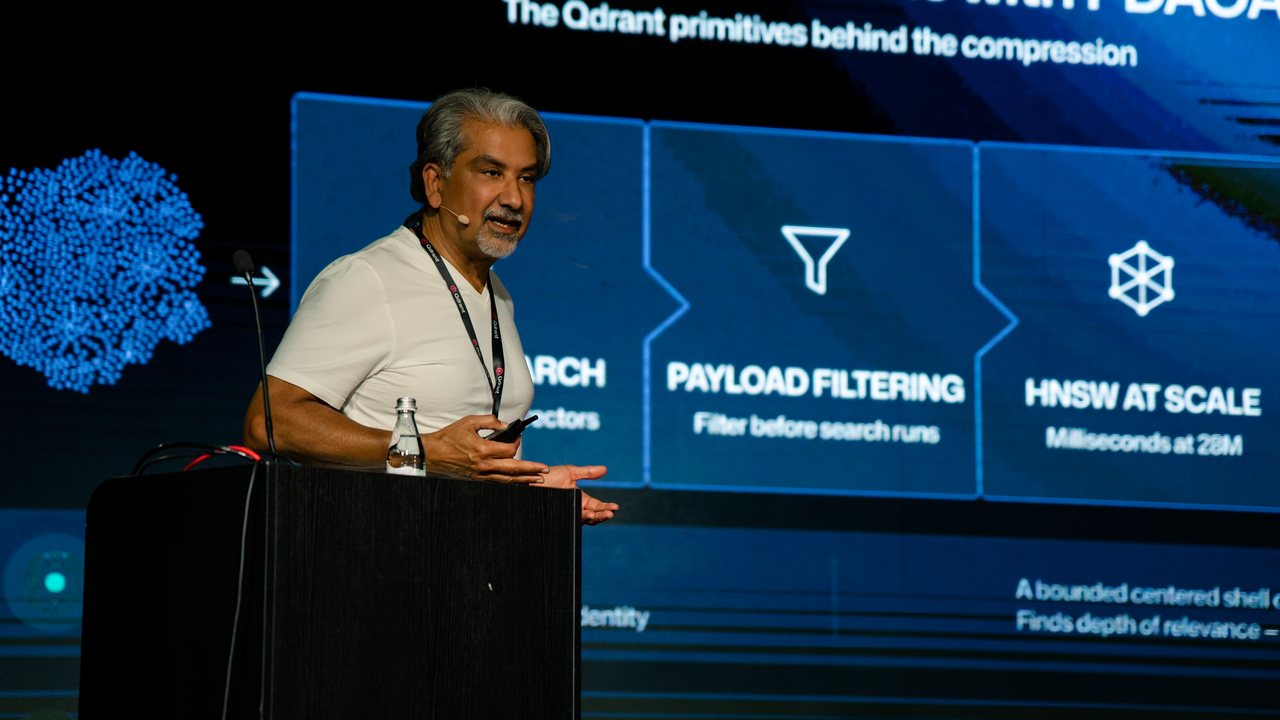
Point it at your corpus.
PubMed, your SOPs, your batch records — same engine, your data, online or on-prem.
Knowledge that moves to where the work is
Indexing the literature is step one. Step two is putting it to use. The batch record is the heart of GMP — PDAOAI runs it. Under a joint development agreement with TechForce Robotics, that capability rides on two autonomous robots inside the facility: PUR-E in the cleanroom, writing the batch record hands-free through its Kebbi voice interface, and LIM-E in the corridors, moving the materials. Phase 1 objectives are complete; both companies are evaluating and co-developing further automation for GMP manufacturing and laboratory workflows.
Two robots, two jobs
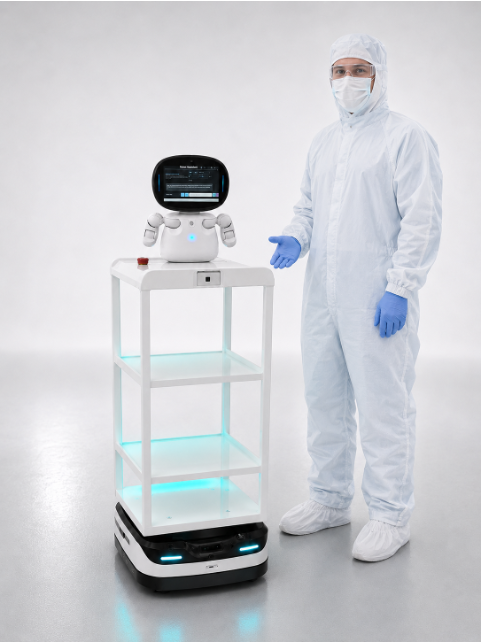
PUR-E™ — Purity In Motion, with Kebbi
The batch record is the heart of GMP — PUR-E runs it. It pulls the room's particle and sterility-monitor readings straight into the eBR, and lets gowned operators dictate batch parameters hands-free through the Kebbi conversational interface — PDAOAI writing the record as the work happens, right the first time.
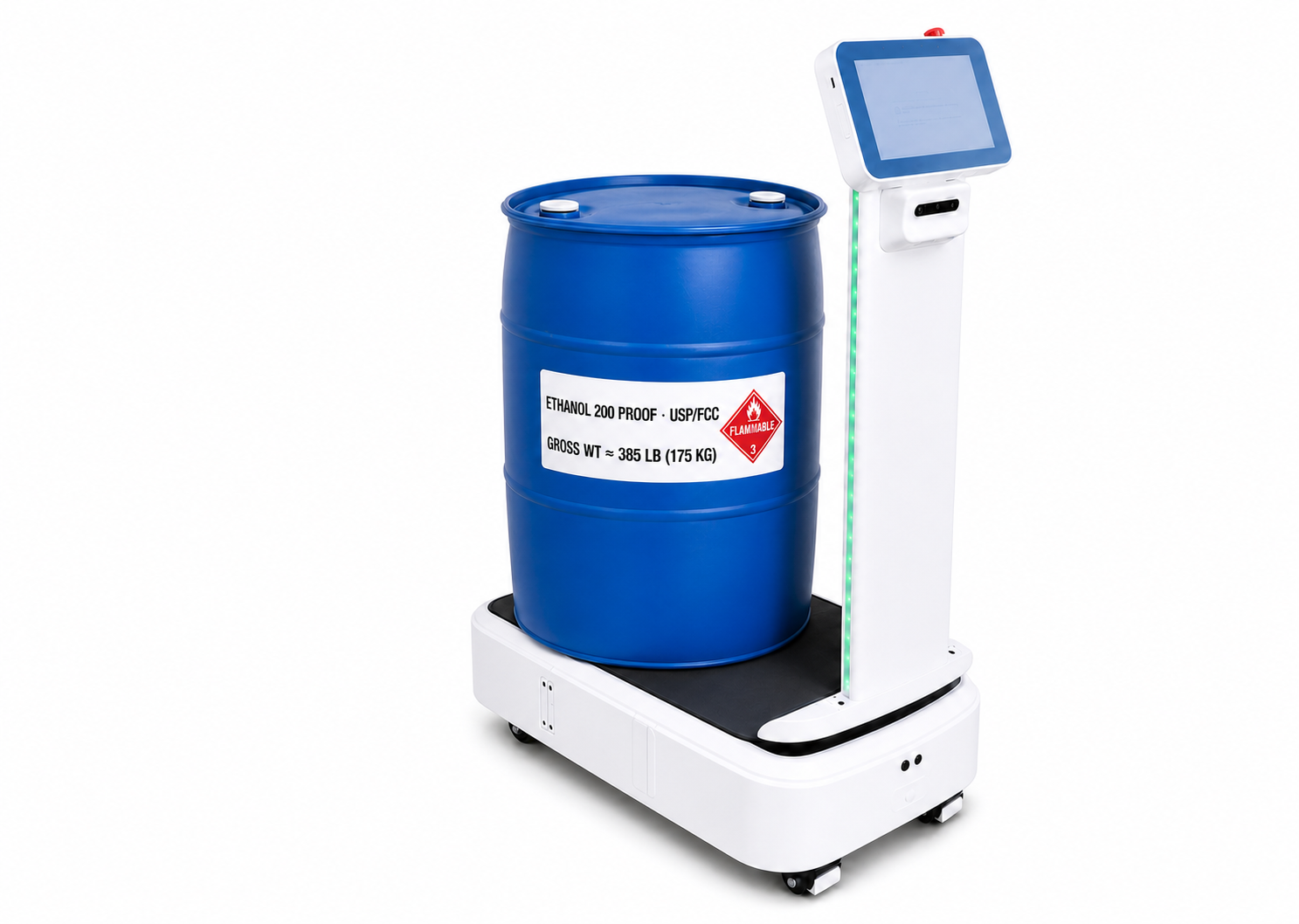
LIM-E™ — Logistics In Motion, Everywhere
Autonomous transport of materials and equipment — trays, consumables, kits, bulk solvent drums, and waste, up to 600 lb per load — running 18–20 hours a day in the non-classified corridors, handing off at the cleanroom pass-through. Built for heavy loads, so qualified staff don't carry them.
Both robots are tested in operating sterile cleanrooms and built for GMP — low-particulate, fully wipe-down construction.
Built for the buffer problem
Biologics purification runs on buffer. A single batch can need tens of thousands of liters — moved as heavy drums and totes between the prep room and the manufacturing suites, through several controlled doors. It is slow, manual, and it ties up trained operators all day.
That is exactly what LIM-E is built for. In a heavy-payload build configured especially for biologics, it hauls up to 2 tons per load — the heaviest totes and bulk buffer, moved autonomously, door to door, so qualified staff never carry them.
What it returns
Conservative, modeled on a mid-size sterile suite (~60 batches/year). Effects shown as ranges and confirmed per facility.
PUR-E™ · Cleanroom & eBR · Must-have
| Batch-record review time | −40–50% |
| Manual data entry | −60% |
| Documentation errors | −50% |
| Batch-release cycle | −40–50% |
| Subscription | under ~1% of suite throughput |
LIM-E™ · Logistics · Efficiency layer
| Material-handler labor | offsets ~1–1.5 porter FTE |
| Payload | up to 600 lb per load |
| Uptime | 18–20 hrs/day · >1 shift |
| Subscription | under ~1% of suite throughput |
Demonstrated live at BIO 2026
PDAOAI with PUR-E & LIM-E were shown on the BIO floor in San Diego — hands-free eBR through Kebbi, AI-assisted documentation, and intelligent robotic integration.
Request a demo →Two AI layers, kept distinct
A robot on a regulated floor runs two different kinds of AI. PDAOAI is the knowledge layer; TechForce's onboard stack drives the robot. Each does a different job.
PDAOAI — the AI knowledge layer
Indexes the totality of biomedical knowledge and proprietary corpora, and embeds it into automated workflows — supporting research, biomarker discovery, regulatory processes, and compliance across pharmaceutical development and manufacturing.
Sensing & navigation
LIM-E runs LiDAR-based SLAM navigation, 3D depth and vision sensing, and adaptive AI that plans movement continuously and reroutes around people and obstacles.
Facility integration
Robots call and ride commercial elevators, open automated and badge-controlled doors, and dynamically reroute when hallways are busy — fitting existing workflows without operational redesign.
Expanding Autonomous Operations into Pharmaceutical Manufacturing
TechForce's autonomous platform has been successfully deployed across hospitality, entertainment, and large-scale commercial environments. The LIM-E deployment represents its first operational expansion into pharmaceutical manufacturing and laboratory operations, where automation must meet the rigorous requirements of GMP compliance, data integrity, and process control.
Combined with PDAOAI's domain-specific knowledge layer, the integrated platform is designed to support scalable pharmaceutical operations by improving workflow efficiency, reducing dependence on manual processes, enhancing documentation accuracy, and strengthening compliance across research, development, and manufacturing environments.
"We are moving from data to real-world application. By embedding the totality of scientific knowledge into robotics, we can look to transform how drugs are developed and produced — not just for us, but for the broader industry." — Dr. Vuong Trieu, Chairman & CEO, Oncotelic
Where it stands
- Phase 1 complete.LIM-E logistics deployment under the joint development agreement.
- Phase 2 underway (June 2026).PUR-E deployed alongside LIM-E in an OEB-5 sterile injectable cGMP facility.
- Knowledge embedded.~28M abstracts integrated for real-time use in the robotics workflow.
- Next.eBR integration, multi-floor navigation, and further GMP workflow automation.
Latest from PDAOAI & the robotics program
Live links to Oncotelic, TechForce, and Sapu Nano releases on GlobeNewswire. Newest first · updated July 1, 2026.
Oncotelic Launches AI-Powered GMP Manufacturing Services Platform at BIO International Convention 2026
Oncotelic (OTCQB: OTLC) · GlobeNewswire
Read the announcement → Robotics · BIO 2026TechForce Advances Pharmaceutical Automation — Phase 2 PUR-E Deployment at the OEB-5 Sterile Injectable cGMP Facility
TechForce Robotics (OTCQB: NGTF) · GlobeNewswire
Read on GlobeNewswire → Drug DiscoveryOncotelic Showcases PDAOAI™ in Advancing Drug Development — Featured in Qdrant Vector Space Day 2026 Keynote
Oncotelic (OTCQB: OTLC) · GlobeNewswire
Read on GlobeNewswire → RoboticsTechForce Robotics Enters Pharmaceutical Automation Market Through Initial LIM-E Deployment at Oncotelic
TechForce Robotics (OTCQB: NGTF) · GlobeNewswire
Read on GlobeNewswire → BIO 2026Sapu Nano Unveils Progress in Deciparticle™ Nanomedicine and AI-Driven Oncology Development at BIO 2026
Sapu Nano · GlobeNewswire
Read on GlobeNewswire → Drug DiscoveryOncotelic Advances Toward Commercial Launch of AI-Enabled Robotics Following Integration of 28 Million Scientific Abstracts
Oncotelic (OTCQB: OTLC) · GlobeNewswire
Read on GlobeNewswire → RoboticsOncotelic Announces Strategic Partnership with TechForce Robotics to Commercialize PDAOAI-Enhanced GMP Robotics
Oncotelic (OTCQB: OTLC) · GlobeNewswire
Read on GlobeNewswire →More on GlobeNewswire: Oncotelic Investors · TechForce Robotics
Search finds the needle. We find the magnet — the thing every needle points to.
Want to see PDAOAI in action?
Researchers, collaborators, and teams evaluating the platform for their own GMP operations — start a conversation.
Email the team →